
Beyond LLMs and Prompts: Smarter AI Agents That Think and Execute
By Ram Biswal • 2/20/2026
Think of AI agents as smart software that can perceive their surroundings and take actions to achieve specific goals, much like a human agent would.
Think of AI agents as smart software that can perceive their surroundings and take actions to achieve specific goals, much like a human agent would. They use artificial intelligence to learn, reason, and make decisions. These agents can be found everywhere, from recommending your next favourite song to helping self-driving cars navigate busy streets. Essentially, they are intelligent systems designed to automate tasks and solve problems independently. In agentic AI frameworks, their ability to adapt, plan autonomously, and learn makes them incredibly powerful.
LLMs: AI That Masters Human Language:
Large Language Models (LLMs) are powerful AI systems trained on vast amounts of text data. They excel at understanding and generating human-like language for tasks like chatting, writing, or answering questions. Popular examples include ChatGPT and Gemini, which respond based on user prompts.
AI Agents vs LLMs:
Goal-Oriented Action: Unlike LLMs that primarily focus on generating text based on prompts, AI agents are designed with specific objectives in mind and can take actions to achieve them. For example, an AI agent designed for travel booking can not only understand your request but also search for flights and hotels, and even make reservations.
Interaction with the Environment: AI agents can interact with their environment, whether it's the digital world (like websites and databases) or the physical world (through sensors and actuators). A Standard LLM doesn't have this capability to actively engage with its surroundings.
Remembering the Past: AI agents can often maintain a memory of past interactions and the current state of their environment. This allows them to make more informed decisions over time. A standard LLM typically processes each prompt in isolation without persistent memory(Standard LLM API calls).
Planning and Decision Making: Agents can plan a sequence of steps to reach their goals, breaking down complex tasks into smaller, manageable actions. While an LLM can generate plans in text, it cannot execute them autonomously.
Tool Use: AI agents can be equipped with and utilize various tools and APIs to extend their capabilities. For instance, an agent might use a calculator to solve math problems or a weather API to provide real-time forecasts. Standard LLM s are limited to their training data knowledge.
Autonomy and Iteration: Once given a goal, agentic AI agents can operate autonomously, iterating through different steps and adapting their approach as needed. LLMs require constant prompting and guidance
For example, consider a customer service chatbot. A Standard LLM could answer questions based on its training data. However, an AI agent-powered chatbot could access customer accounts, process orders, and resolve issues by interacting with various systems – actions a Standard LLM cannot perform.
Another example is a smart home assistant that uses an AI agent to control lights, thermostats, and appliances based on your preferences and sensor data, going beyond simply understanding voice commands.
TOOLS : ASSISTANT OF AI AGENTS
Tools are crucial for empowering AI agents in agentic AI. Think of them as the agent's hands and eyes in the digital or physical world. These tools provide agents with specific capabilities to interact with their environment, access information, and perform actions.
For example, an AI agent designed for research might utilize a web scraping tool to gather data from websites, a natural language processing (NLP) tool to analyse text, and a database connector to store and retrieve information.
Agentic AI System for Sales Data Analysis:
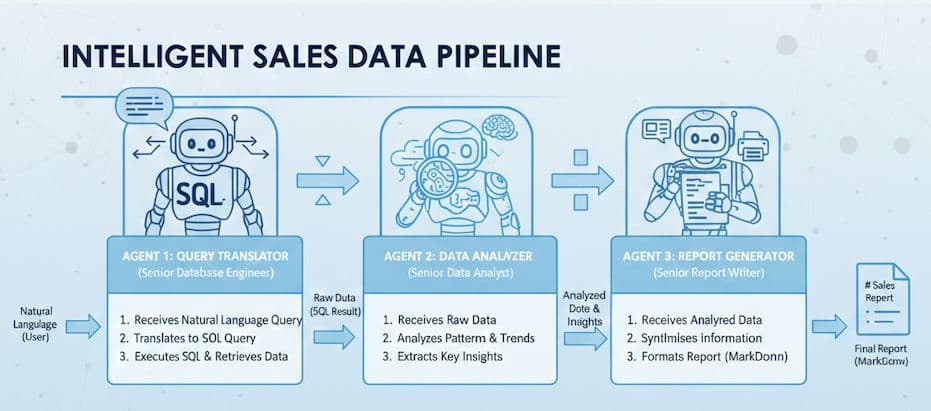
This system leverages a multi-agent approach to efficiently handle user queries against our sales record database and generate insightful reports.
Agent 1: Senior Database Engineer (Query Translator):
Responsibility: Receives natural language user queries related to sales data.
Function: Translates the user's query into a SQL query.
Action: Executes the generated SQL query against the sales record database to retrieve the relevant data.
Output: Passes the raw data retrieved from the database to Agent 2.
Agent 2: Senior Data Analyst (Data Analyzer):
Responsibility: Receives the raw sales data from Agent 1.
Function: Analyzes the retrieved data to identify patterns, trends, and information relevant to the original user query.
Action: Interprets the data and extracts key insights.
Output: Forwards the analyzed data and key findings to Agent 3.
Agent 3: Senior Report Writer (Report Generator):
Responsibility: Receives the analysed data and key findings from Agent 2.
Function: Synthesizes the information into a comprehensive and user-friendly report.
Action: Formats the report using Markdown for clear presentation.
Output: Generates a final report in Markdown format addressing the user's initial query with relevant data insights.
Multi-agentic AI approaches overcome LLM limits via modularity (3-Agent Approach):
This multi-agent system effectively addresses key limitations encountered when using a monolithic Large Language Model (LLM) for complex data analysis and reporting on large datasets.
Context Window Limitations: Direct input of a large sales record database into an LLM is impractical due to the inherent context window size restrictions of even the most advanced models. This approach bypasses this limitation by having Agent 1 query and retrieve only the necessary data subset relevant to the user's specific request.
Specialized Expertise: By assigning distinct roles to each agent (database interaction, data analysis, and report writing), the system leverages specialized "expertise" at each stage. This can lead to more accurate SQL queries, deeper data insights, and well-structured, informative reports compared to a single LLM attempting all tasks.
Improved Efficiency and Scalability: Breaking down the process into sequential agent workflows can improve efficiency. Agent 1 focuses solely on data retrieval, Agent 2 on analysis, and Agent 3 on presentation. This modularity also enhances scalability as individual agents can be optimized or scaled independently as needed.
Enhanced Interpretability and Debuggability: The clear separation of tasks makes the entire process more transparent and easier to debug. If an issue arises, it's more straightforward to pinpoint which agent's process needs attention (e.g., an incorrect SQL query from Agent 1 or a flawed analysis from Agent 2).
Summary
AI agents are powerful, autonomous systems that surpass plain LLMs by actively interacting with environments, using tools, and pursuing goals. Unlike LLMs, which focus on text generation, AI agents plan, act, and adapt independently, as seen in applications like travel booking. A multi-agent system for sales data analysis—featuring specialized agents for query translation, data analysis, and report generation—demonstrates their efficiency, scalability, and precision. By leveraging modularity and tools, AI agents address complex tasks with unparalleled effectiveness, making them vital to modern AI solutions.
Loading comments...