
Data Migration Made Easy: Build a Robust Data Validation Framework for Perfect Results

By Sankar Cherukupalli • 6/18/2025
Increase the success of your data migration projects! Understand how the Data validation framework upholds data quality, accuracy and integrity. Save time, minimize errors and enhance operational productivity.
Based on various data projects I have conducted, what concerns you the most when transferring sensitive business data to a new system? Is it the possible system failures or delays caused by technologically induced escalations? While these may hinder progress, the worst case scenario revolves around poor data quality. Data “corruption” or destruction as a process or model data’s system cutover leads to a range of operational barriers, inaccuracies in reporting, and negative impacts on organizational decision-making. This scenario underscores the importance of implementing robust frameworks where there is a data validation framework for every data migration project.
Consider it as a checkpoint or gate for your information in the digital world. A good data validation framework enables you to set different requirements that your data must meet to in order to be accepted such as its quality, consistency, and accuracy before leaving its base, and afterward during the entire movement process, so that after reaching its destination, the data is indeed valuable not just functional. In its absence, there is a possibility of encountering numerous problems that would surely underestimate your reputation while overestimating the negative impact on your business analytics accuracy and customer centered satisfaction. In this article, we discuss everything you need to know about building such a framework and comprehend how it supports optimal migration plan strategies to make your organization successful.
Issues Relating To Migration Of Untested Data
As already mentioned, variation with data validation processes marks the line between success and failure. With no such process in place, migrating data gives founders or directors a sort of Tarzan leap into danger, the risks can simply be called a catastrophe. A disaster cycle often revolves around these critical issues and here is how they will impact your operations:
1. Data Loss
Data migrations can be likened to relocating to a new house. Without a careful move, personnel tracking problems may lead to necessary boxes being "dropped" in the process, similar to data transformation checkpoints. In the migration process, confirmation mechanisms are essential as they ensure records are not misplaced or incomplete data fragments are captured in erroneous systems.
2. Data Corruption
While many cases discuss the possibility of data being ‘lost’ in the process; it is equally probable, even more likely in some contexts, that data is altered through transfer errors. There are many ways that factors beyond one's control can cause loss of critical business information. Take for instance mismatch in file structures of source and target systems. With no structured validation checks, critical values could get irreparably trapped to ye olde data structures that are null, resulting in a cascading avalanche of chaos waiting to happen, pardon my French.
3. System Downtime
Poor data quality might also lead the new system (post-migration) to come alive with glitches or require extensive repairs post-migration fix-up during heavy overtime or after hours. Imagine needing financial capabilities in your software only to have it malfunction, due to corrupted registers, and just relying on estimates for everything. Given the automated, computerized, but not human-based calculations this could shut down core functionalities – which is stability in this scenario.
4. Time and Cost Overruns
The cost attributed to fixing errors with a system has increased exponentially when done long after core processes begin operating. Performing checks saves money by “forcing” companies into scenarios where they “need to pay in advances.” Expenditures allow terrible approaches challenge you against reality after-which serve no purpose.
These well crafted guidelines form the preventative measures, which should be seen as repeating patterns. Carefully examining complexity and chaos guarantees effortless transitions when in reality speed is often desired, and this all while keeping the elements intact.
Building a Data Model for Validation Framework
Creating a data validation framework starts with having a structured model for your data which can serve as the backbone or skeleton one may call it.
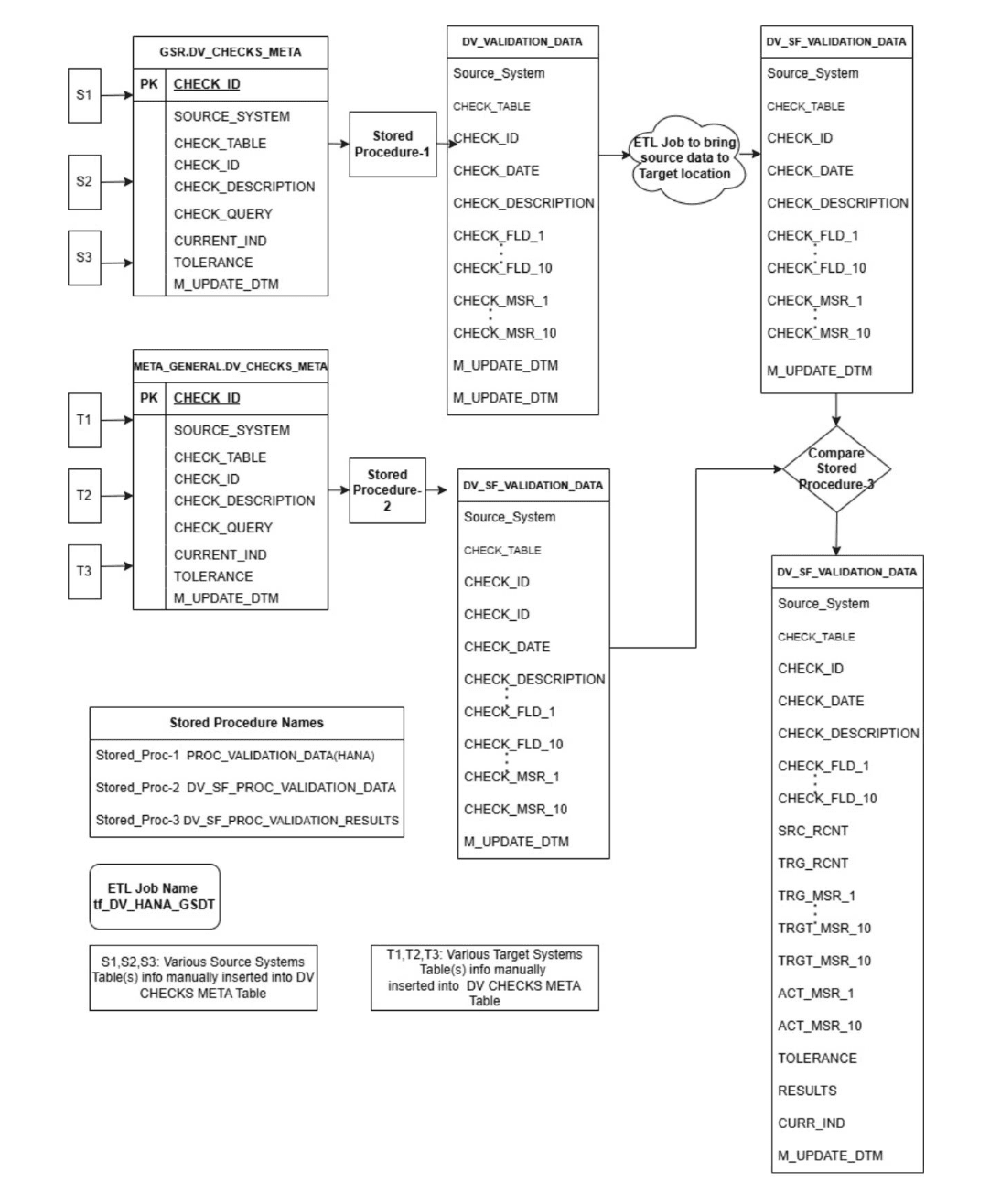
Here are some components of the system for data quality.
1. Source/Target System Data Quality (DQ) Rule Table
This document contains the most fundamental quality rules pertaining to your data. It is essentially your rulebook where you document specific data fields to check, how to check them, and their value. It sets the boundaries of what to monitor.
Important Fields in the Table:
DQ_Rule_ID: A unique numeric identifier for each rule (Primary Key).
DQ_Rule_Name: A description of the validation rule.
DQ_Rule_Table: The name of the table the rule evaluates.
DQ_Rule_Query: The SQL query defining the validation rule.
DQ_Rule_Flag: A boolean flag (0 or 1) indicating whether the rule is active or inactive.
Source System: Where the data originates.
Criticality_Level: Classification as High, Medium, or Low based on priority.
Threshold_Level: Accuracy level defined by a numeric value.
Target System: The destination system for data migration.
Source Availability Flag: Indicates if the data exists in the source system.
Target Availability Flag: Indicates if the data exists in the target system.
Manually populating this table lays the groundwork for your entire validation framework.
2. Source/Target Validation Data Table
Stored Procedures are created to iterate over all the DQ_Rule_IDs stored in Source System DQ Rule Table and executes in sequential manner. Results of DQ_Rule_query is stored in this Data Table. This Table stores only most recent copy of every DQ_Rule_ID which gets executed through this procedure.
Stored procedure Pseudocode:
· Delete the data from this DataTable for the active DQ_RULE_ID.
· Get the list of all DQ_Rule_Queries with DQ_Rule_Flag active values.
· Iterate though all the Active DQ_Rule_Query and execute in sequential fashion and store the results in this Data Table.
3. Transfer Source Validation Data Table to Target System
Create a Data pipe line to move Source Data Validation Table to Target system to compare Source and Target Data Validation Tables. The movement of this data enables real-time comparison and ensures synchronized validation across systems.
4. Validation Results Table
Create a Stored Procedure to combine the data of both Source and Target system data tables and then to compare the Source and Target measures for the specified dimensions.
Matched Results Analysis:
If all the values of Source and Target measures match then mark Result as “PASS” else “FAIL”.Unmatched Results Analysis:
Measures mismatch can be due to either missing records or mismatch of measure values.
Case 1: Mismatch due to Missing Records
Measures mismatch can be due to missing records either from Source or Target System. Source or Target System missing records can be identified through Source/Target AvailabilityFlag.
Case 2: Mismatch due to measures discrepancy
All the rows are available both from Source and Target, however if all the measures between source and target are not matching and also not meeting defined threshold level then mark Result as “FAIL”
This granular breakdown helps you pinpoint and address specific issues, ensuring thorough data quality checks. Artificially defining such mix-boundaries allow teams to automate so much validation that manual oversight is scarce.
Recommended Strategies for Integration of A Data Validation Framework
Following these guidelines developed from experience with data migration projects will surely enhance your data validation framework.
1. Establish Measurable Data Quality Indicators
Every project should initiate with key questions. In this case, ask yourself “What standards must our data fulfill?” In this case, you may consider setting a KPI metric like a 99% accuracy threshold for critical indicators such as revenue figures. Having defined measurement metrics set validation tiers in the verification process.
2. Consider Validation Steps That Are Sequential
When working on validation processes regarding data, partition the tasks into smaller, more manageable actions such as basic checks for formats and data existence or system interoperability checks. Validation layers such as these help ensure that the entire process is interoperable.
3. Embrace Modern Real-Time Monitoring Technology
Addressing issues in real-time could prove beneficial. This can be achieved through dashboards used to monitor compliance KPIs leading from one integration step to another. Automate flags that alert visible discrepancies without impediment to efficient work.
4. Use Coordinated Test Runs
Testing migration data before the entire process is complete allows for real-time bug detection. An example could include running source and target systems test to validate high volume transactions.
5. Systematize For Regular Audit Of Control Processes
In the above stated cases, rules were called business rules. The construct contains within it a validation framework, thus, rules or a set of documents encapsulating the business logic must be derived and appropriately reasoned warranting regular audits.
Make sure your system allows reconfiguration of data quality rules and other corresponding elements while supporting easy updates with minimal development efforts.
The All-Important Difference Data Validation: Real Life Examples
Let’s take a look at some real life scenarios to appreciate the significance of a data validation framework.
Retail Industry
An international retailer migrated their inventory management database to a cloud-based system. Prior to implementing validation logic, discrepancies between the inbound shipments (source) and warehouse inventories (target) caused actual customer delays. The company achieved an 85% reduction in fulfillment errors by implementing validation logic for mismatched product counts due to order packed versus order shipped mismatches.
Healthcare Sector
A hospital group had data accuracy problems in some fields, especially in prescription histories, after modernizing patient records. Such invalid entries created risks pertaining to safety. With the iterative validation framework, the hospital set a threshold for validation to ensure all prescription records cross-checked against set thresholds validating 99.9% accuracy.
Importance of Having a Well Defined Data Validation Framework
At a minimalistic understanding, the data validation framework is the mental model focused on successfully migrating data and holds everything together. It serves as the backbone of data migration and healthcare policy to mitigate risks while increasing trust and certainty in digital transformation.
As a lever you can pull, consider anything from a financial institution migrating sensitive customer information to an e-commerce retailer integrating their supply chain systems. Irrespective of the nature and scale of a business, validation ensures the business does not work under risk-prone inefficient customer-confident systems.
As We Conclude
Data migration can be viewed as constructing a bridge to the future of your organization. But, without a robust data validation process, the bridge turns into an unstable superstructure. By addressing risks head-on, adhering to industry standards, and strategically investing in automated technology, you place your organization not only on the path to a seamless transition, but, on a trajectory to sustained confidence and growth.
Loading comments...