
How Artificial Intelligence is Transforming Business Intelligence Tools

By Hanumanthrao S • 3/13/2026
A Comprehensive Guide to AI-Powered Analytics
Introduction
Business Intelligence (BI) tools have long been essential for organizations seeking to make data-driven decisions. However, the integration of Artificial Intelligence (AI) is revolutionizing these tools, transforming them from static reporting systems into dynamic, predictive, and intelligent platforms that empower users at all skill levels.
Traditional BI tools required extensive technical expertise, manual data preparation, and backward-looking analysis. Today's AI-powered BI platforms automate complex processes, predict future trends, and enable anyone in an organization to extract meaningful insights through simple, conversational interfaces.
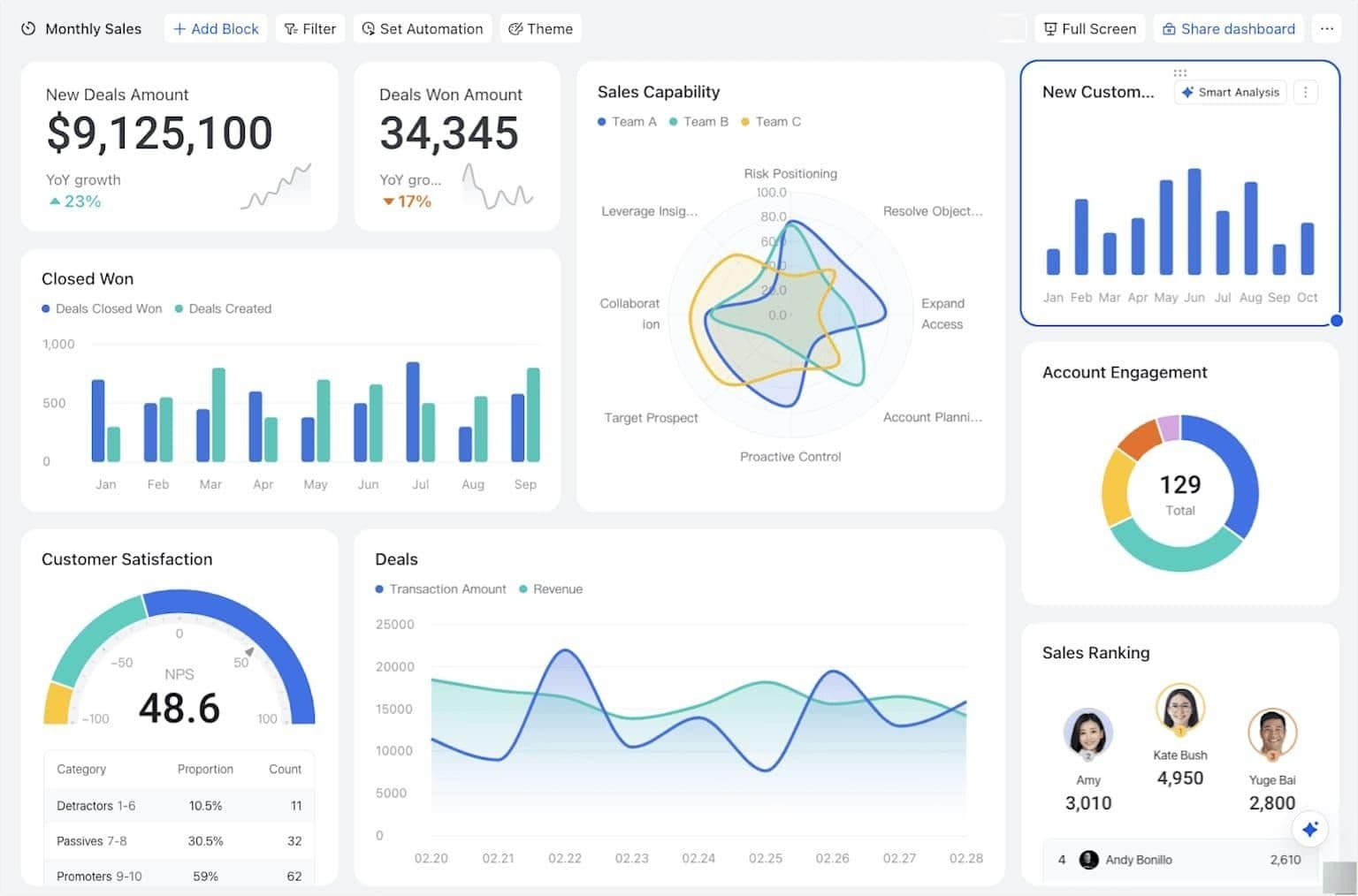
Modern AI-powered business intelligence dashboard showing comprehensive sales analytics with predictive capabilities
How AI Enhances Business Intelligence Tools
1. Automated Data Cleaning and Integration
One of the most time-consuming aspects of traditional BI has been data preparation. AI dramatically reduces this burden by automating the Extract, Transform, and Load (ETL) processes. AI automates data cleaning, mapping, and integration across multiple sources, reducing manual effort by up to 80%. Platforms like Microsoft Power BI and Tableau Prep use machine learning to automatically standardize and integrate data from databases, cloud services, and APIs.
2. Advanced Predictive Analytics
AI transforms BI from descriptive to predictive and prescriptive analytics, enabling sales forecasting, customer churn prediction, inventory optimization, risk assessment, and fraud detection. Tools like Tableau with Einstein Discovery and Qlik Sense analyze historical data to generate predictions with confidence intervals, helping organizations proactively address challenges.
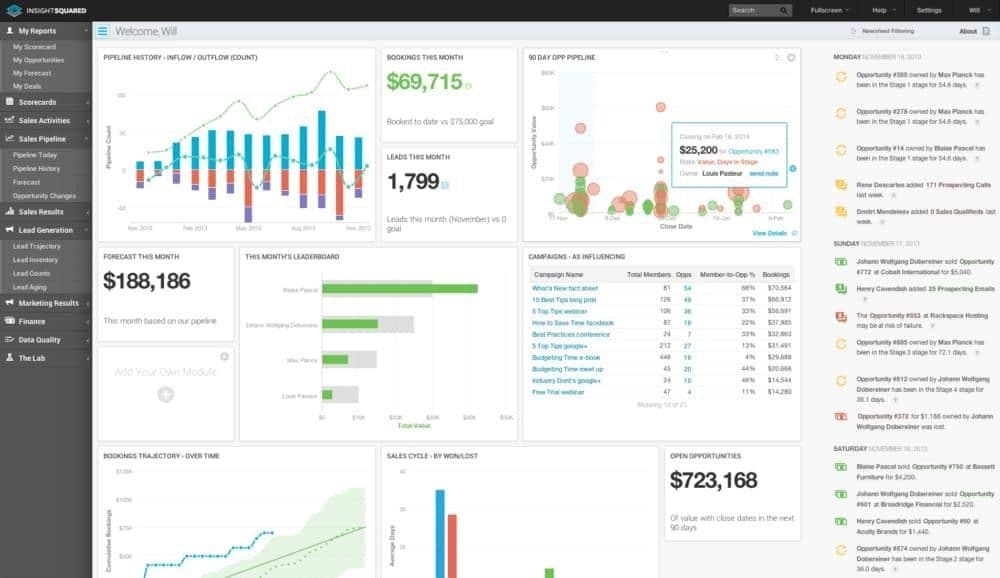
Predictive analytics dashboard showing pipeline forecasting, opportunity tracking, and sales performance metrics
3. Natural Language Processing and Querying
Natural Language Processing (NLP) allows users to interact with data using plain English questions like "What were our top-selling products last quarter?" or "Show me sales trends by region." The AI interprets questions, queries data sources, and generates visualizations instantly. Platforms like ThoughtSpot, Power BI Q&A, and Tableau Ask Data have made conversational analytics mainstream.
4. Intelligent Visualization and Dashboard Generation
AI-powered BI tools automatically select appropriate visualization types, personalize dashboards based on user roles, highlight anomalies, and enable interactive drill-down capabilities. Tools like Qlik Sense, Sisense, and Domo analyze data characteristics and user intent to generate effective visual representations automatically.
5. Real-Time Monitoring and Automated Alerts
AI enables continuous monitoring of key metrics with automated alerts for anomalies, threshold breaches, and emerging opportunities. The system provides predictive warnings, contextual recommendations, and multi-channel notifications (email, SMS, Slack, Teams), ensuring decision-makers are informed immediately when action is needed.
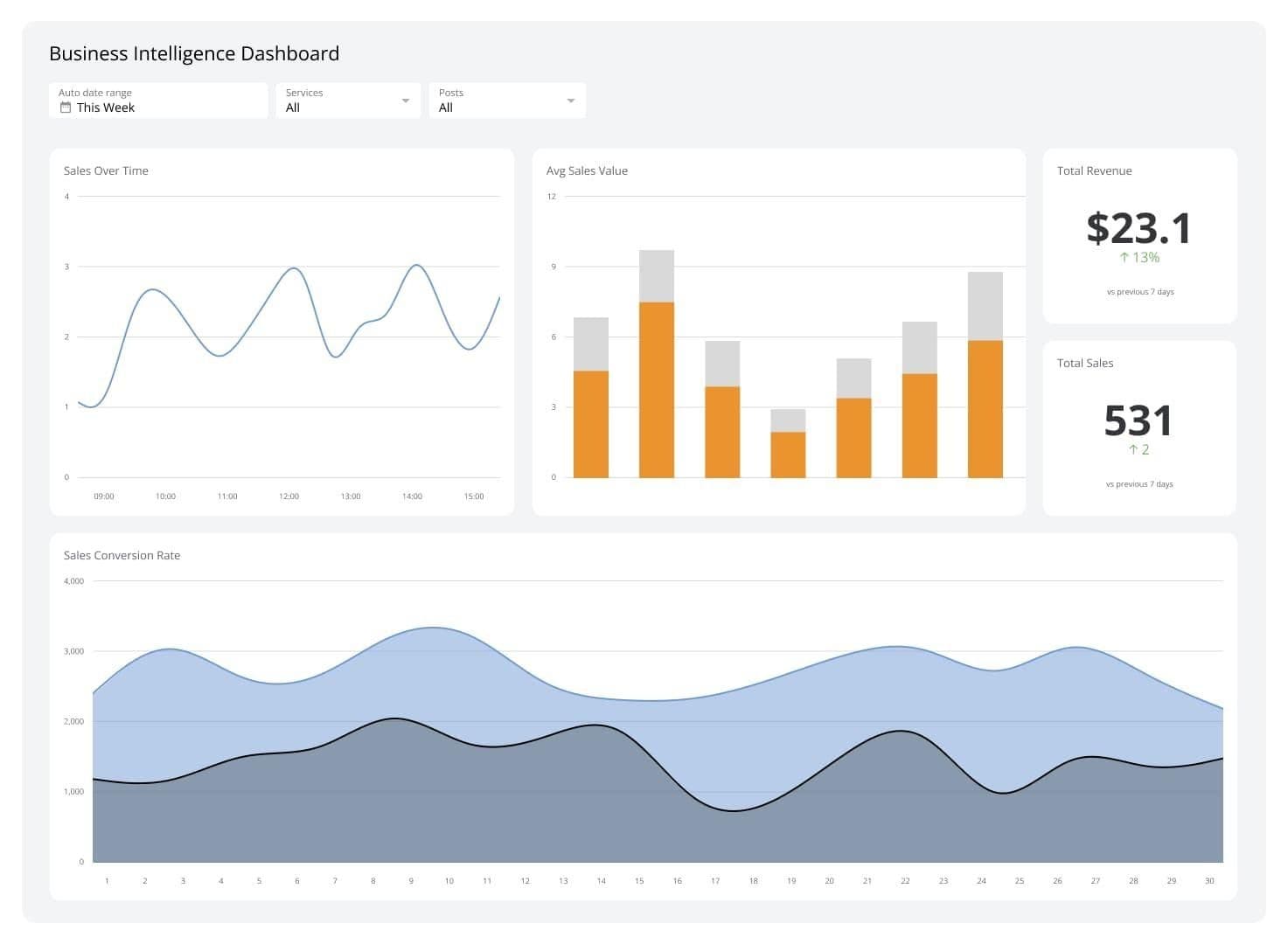
Real-time BI dashboard displaying sales metrics, conversion rates, and performance indicators
6. Democratization of Data Analytics
AI democratizes analytics through no-code dashboard creation, automated insight generation with natural language explanations, guided analytics with AI-suggested next steps, and self-service reporting. Platforms like Polymer, Akkio, and Zoho Analytics empower business users with powerful analytics without requiring technical expertise.
Real-World Applications
Retail: AI enables demand forecasting, customer segmentation, dynamic pricing, and personalized product recommendations that increase conversion rates.
Finance: Real-time fraud detection, credit risk assessment, regulatory compliance monitoring, and customer churn prediction inform retention strategies.
Healthcare: AI predicts patient outcomes, optimizes resource allocation, analyzes treatment costs, and provides clinical decision support at point of care.
Manufacturing: Predictive maintenance prevents equipment failures, computer vision detects defects, and AI optimizes supply chains and production efficiency.
Key Benefits Summary
Speed - Analysis that took days now completed in minutes or seconds.
Accuracy - AI reduces human error in data processing and analysis.
Accessibility - Non-technical users can perform sophisticated analytics.
Proactivity - Predictive insights enable preventive action rather than reaction.
Scalability - AI handles massive datasets beyond human processing capability.
Cost Savings - Automation reduces labor costs and improves resource allocation.
Competitive Advantage - Faster, better insights lead to superior strategic decisions.
Summary of key benefits from AI integration in BI tools
Challenges and Considerations
Data Quality: AI models require high-quality training data and robust governance frameworks to ensure accurate predictions and insights.
Privacy & Security: Organizations must comply with GDPR, CCPA, and other regulations while implementing secure data storage and transparent usage policies.
Bias & Fairness: Regular audits are needed to prevent AI from perpetuating biases, requiring diverse training data and human oversight for critical decisions.
Skills Gap: Success requires staff who understand both business and AI capabilities, necessitating investment in training and change management.
Implementation Costs: Initial investment and system integration can be substantial, with ROI taking time to materialize.
Future Trends
The next generation of AI-powered BI will feature augmented analytics that explains reasoning and automates decisions, edge analytics for faster insights with enhanced privacy, and conversational AI enabling voice-activated data exploration. AutoML will allow users to build predictive models without data science expertise, while embedded AI will provide contextual insights directly within operational applications. Collaborative AI will act as a team partner, tracking discussions and suggesting analyses.
Conclusion
Artificial Intelligence has fundamentally transformed Business Intelligence tools from static reporting systems into dynamic, predictive, and accessible platforms that democratize data-driven decision-making across organizations. The automation of routine tasks, advanced predictive capabilities, natural language interfaces, and intelligent visualizations have made sophisticated analytics available to users at all skill levels.
Organizations that embrace AI-powered BI gain significant competitive advantages through faster insights, better predictions, and more informed strategic decisions. However, success requires addressing challenges related to data quality, privacy, bias, and organizational change management.
As AI technology continues to advance, the gap between human questions and data-driven answers will continue to narrow, making intelligence truly accessible and actionable for every business user. The future of BI is not just intelligent—it's augmented, conversational, and seamlessly integrated into the flow of work.
The key to success lies not in the technology itself, but in how organizations leverage these powerful tools to enhance human decision-making, foster data literacy, and build cultures that value evidence-based action.
Loading comments...